Thermal optics have always offered hunters a tremendous advantage after dark, but adding a dependable laser rangefinder and ballistic calculator has traditionally pushed the price beyond what many shooters could justify. The DNT Optics Hydra HS225R attempts to change that.
The HS225R combines a thermal riflescope, clip-on thermal device, handheld monocular, laser rangefinder, and ballistic calculator in one compact package. Instead of carrying a separate scanner and rangefinder—or estimating distance through a thermal image—the shooter can detect, range, and engage a target using a single optic.
That combination makes the Hydra HS225R one of the more interesting entry-level thermal scopes currently available. But its real value is not based on one headline feature. It comes from how several useful technologies work together in the field.
A True Multi-Purpose Thermal Optic
The Hydra HS225R is designed to perform three primary jobs:
- Standalone thermal riflescope
- Front-mounted thermal clip-on
- Handheld thermal monocular
The included QDM150 quick-detach mount makes it possible to transition between handheld scanning and rifle-mounted use. According to DNT, the mounting system allows the optic to be removed and reattached without requiring the shooter to re-zero it.
The HS225R Thermal Sensor
At the center of the HS225R is a 256×192, 12-micron uncooled thermal sensor with a sensitivity rating of ≤25 mK NETD. It uses a 25mm objective lens and provides 3× base magnification, with digital magnification settings of 3×, 4.5×, 6×, 9×, and 12×.
The 50-frame-per-second refresh rate helps movement appear smooth while tracking hogs, coyotes, or other animals. The image is displayed through a 1024×768 Micro-OLED screen, which is considerably higher in resolution than the thermal sensor itself.
DNT also incorporates its Image Super Resolution technology. ISR digitally processes and enhances the sensor output, with DNT describing the resulting image as approaching the apparent detail of a 384-resolution system.
That does not transform a 256 sensor into a true 384 sensor, and buyers should maintain realistic expectations. However, digital enhancement can improve edge definition and make details easier to interpret—especially at practical hunting distances.
The HS225R has a horizontal field of view of approximately 12.3 yards at 100 yards. Its 3× base magnification is well suited to hunters who primarily operate in fields, powerline cuts, and other moderately open areas. Hunters working at very close distances in thick cover may prefer a thermal with lower base magnification and a wider field of view.
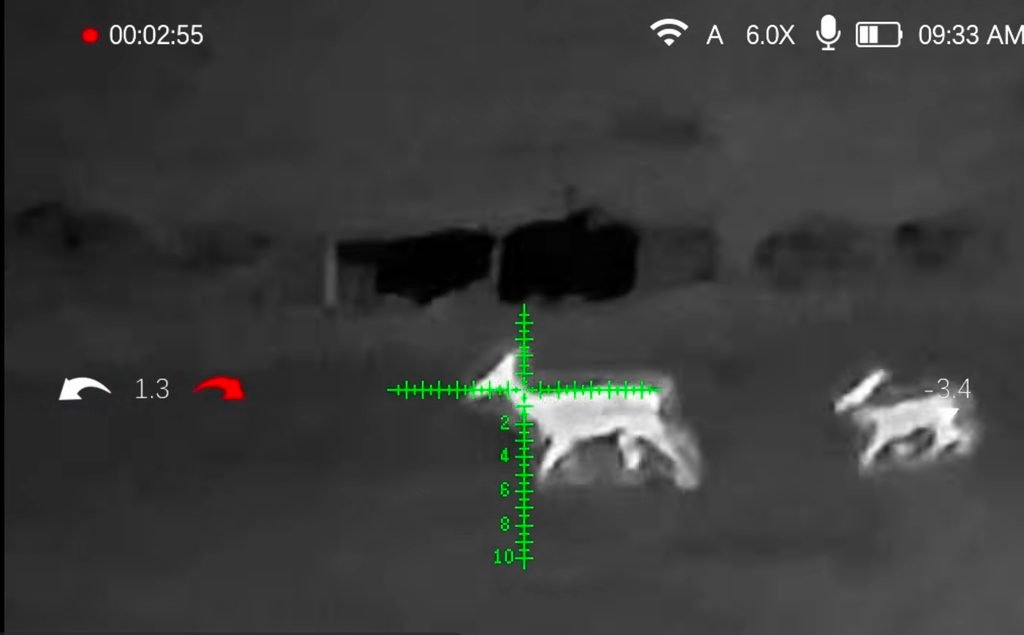
The Built-In Laser Rangefinder
Judging distance through a thermal optic can be surprisingly difficult. Darkness removes many of the familiar visual references we use during the day, while a thermal image can flatten the appearance of terrain. A hog standing 125 yards away may look nearly identical in size to a larger hog considerably farther away.
The HS225R addresses that problem with an integrated laser rangefinder rated to measure from 5 to 1,300 yards. The ranging result appears directly inside the display, so the shooter does not need to lower the rifle or switch to another device. DNT Optics lists the rangefinder’s operating range as 5–1,300 yards.
It is important to understand that 1,300 yards is the rangefinder’s maximum advertised measurement distance—not necessarily the distance at which the 256×192 thermal sensor can positively identify an animal. Actual ranging performance can also vary with target size, reflectivity, weather, angle, and atmospheric conditions.
How the Rangefinder Operates
The laser rangefinder has its own dedicated ranging button. The user centers the on-screen LRF marker on the intended target and presses the button. The optic emits a laser pulse, measures how long it takes that pulse to return, calculates the distance, and displays the result in yards or meters.
The HS225R offers three ranging modes:
Continuous ranging: Pressing the ranging button activates the rangefinder, and the displayed distance updates as the target or shooter moves. This is particularly useful when animals are approaching, retreating, or crossing uneven terrain. A long press of the ranging button turns continuous ranging off.
Single-pulse ranging: Each press produces one measurement. The distance remains visible, but the optic does not continue firing the laser. Pressing the button again takes another reading. The function shuts down automatically after 20 seconds of inactivity.
Timed ranging: The user can select a three-, five-, or ten-second ranging period. The measured distance remains displayed for the chosen duration, after which the rangefinder turns itself off. Pressing the ranging button again restarts the measurement and timer.
These options let the hunter balance convenience with battery conservation. Continuous mode is ideal for changing distances, while single-pulse mode is usually sufficient for a stationary animal or known landmark. The operating instructions are detailed in the official Hydra-LRF user manual.
How the Ballistic Calculator Uses the Range
The rangefinder becomes even more valuable when paired with the DNT Ballistic Engine.
After the shooter enters the necessary information for the rifle and ammunition, the scope uses the measured range to calculate the projectile’s expected drop. The HS225R can store five ballistic profiles, labeled A through E, allowing it to accommodate different rifles, loads, or subsonic and supersonic ammunition.
Profiles can be configured through the optic or managed through the DNT mobile app. Depending on the selected aiming method, the scope can present the solution in one of two ways:
Holdover mode displays a separate holdover marker showing the corrected point of aim.
Dial-In mode provides a correction value that can be expressed in MOA, MRAD, centimeters, or inches.
The practical sequence is straightforward:
- Select the correct ballistic profile.
- Place the LRF marker on the target.
- Press the ranging button.
- Allow the optic to measure the distance.
- Read the calculated ballistic solution.
- Use the displayed holdover marker or correction value.
The calculator can only be as accurate as the information entered into it. Muzzle velocity, ballistic coefficient, sight height, zero distance, temperature, and other variables should be verified rather than guessed. Shooters should confirm the resulting solutions at the range before relying on them in the field.
Thermal Palettes and Image Controls
No single thermal palette works best in every environment. The Hydra HS225R provides eight color palettes, including familiar options such as White Hot, Black Hot, Red Hot, and Iron Hot.
White Hot and Black Hot are useful for general observation and often provide the most natural-looking thermal image. Red Hot can make warm objects stand out rapidly, while Iron Hot provides more color separation between temperature levels.
The user can also select Natural, Enhanced, or Highlight imaging modes and manually adjust contrast, brightness, and sharpness. Hotspot Tracking places an indicator on the warmest point in the image, which can help locate a partially concealed animal.
A manual focus ring allows the image to be sharpened for the target’s distance. This adjustment is especially important with lower-resolution thermal sensors, where proper focus can make a meaningful difference in target identification.
Recording and Connectivity
The HS225R includes 32GB of internal storage for recording field footage. Its Recoil Activated Video feature can automatically preserve footage surrounding a shot, reducing the chance that the user will forget to begin recording during a fast-moving encounter.
Wi-Fi connectivity allows the scope to communicate with the DNT app. Through the app, users can:
- View a live stream from the optic
- Access and organize recorded videos
- Save footage to a phone or tablet
- Edit and share recordings
- Configure ballistic profiles
- Manage compatible device functions
The USB-C port can also be used to connect the scope to a computer and access recordings as files. It can accept a five-volt external power source, but it does not charge the installed battery. The removable 18650 battery must be charged in an external charger.
For hunters who record YouTube videos or want to review what happened during a hunt, the internal recording and app connectivity add considerable value.
Battery Life and Field Durability
The HS225R runs on a removable flat-top 18650 battery, with DNT advertising up to 5.5 hours of operation per battery. The current package includes two batteries, potentially providing approximately 11 hours of total operating time under ideal conditions.
Actual runtime will vary with temperature, Wi-Fi use, recording, rangefinder activity, display brightness, and other settings. Carrying charged spare batteries remains a smart precaution during longer hunts.
The optic weighs 14.4 ounces without the battery and mount and measures approximately 8.0×2.7×2.0 inches. Total weight with the battery and mounting system is approximately 21.3 ounces.
It carries an IP67 ingress-protection rating and is designed to resist dust and temporary water immersion. DNT also rates the optic for recoil up to .50 BMG. Its specified operating-temperature range is -4°F to 122°F. Complete technical specifications are available from DNT Optics.
Where the Hydra HS225R Fits Best
The HS225R is best understood as a feature-rich entry point into thermal hunting—not as a replacement for a premium 384- or 640-resolution optic.
Its 256×192 sensor should perform well for detection and practical hunting at moderate distances, but positive identification becomes more challenging as distance increases. Digital zoom enlarges the displayed image, but it cannot create all the detail captured by a higher-resolution sensor.
The 3× base magnification is another important consideration. It provides useful image scale at moderate range, but it produces a narrower field of view than a 1× or 1.5× thermal. That makes the HS225R more naturally suited to field hunting than close-range scanning in heavy timber.
Its strongest advantages are the integrated rangefinder, ballistic calculator, removable battery, recording system, and ability to serve multiple roles. Those features address real problems hunters encounter rather than merely adding impressive numbers to a specification sheet.
Final Thoughts
The DNT Optics Hydra HS225R brings together capabilities that once required several separate devices. It can scan as a handheld monocular, mount as a standalone thermal riflescope, operate as a clip-on, record a hunt, measure the target’s distance, and calculate a ballistic correction.
The laser rangefinder is arguably its most important feature. Thermal vision can show that an animal is present, but the rangefinder tells the hunter how far away it actually is. When that measurement is passed to the ballistic calculator, the HS225R turns raw thermal detection into more useful shooting information.
Buyers must remain realistic about the limitations of a 256×192 sensor and 3× base magnification. Nevertheless, for hunters seeking an affordable thermal optic with an integrated LRF—and who value versatility more than maximum image resolution—the Hydra HS225R delivers an unusually complete set of features in one compact system.